Launch offer — valid today only

📄 Digital book in PDF · read it on your phone or print it

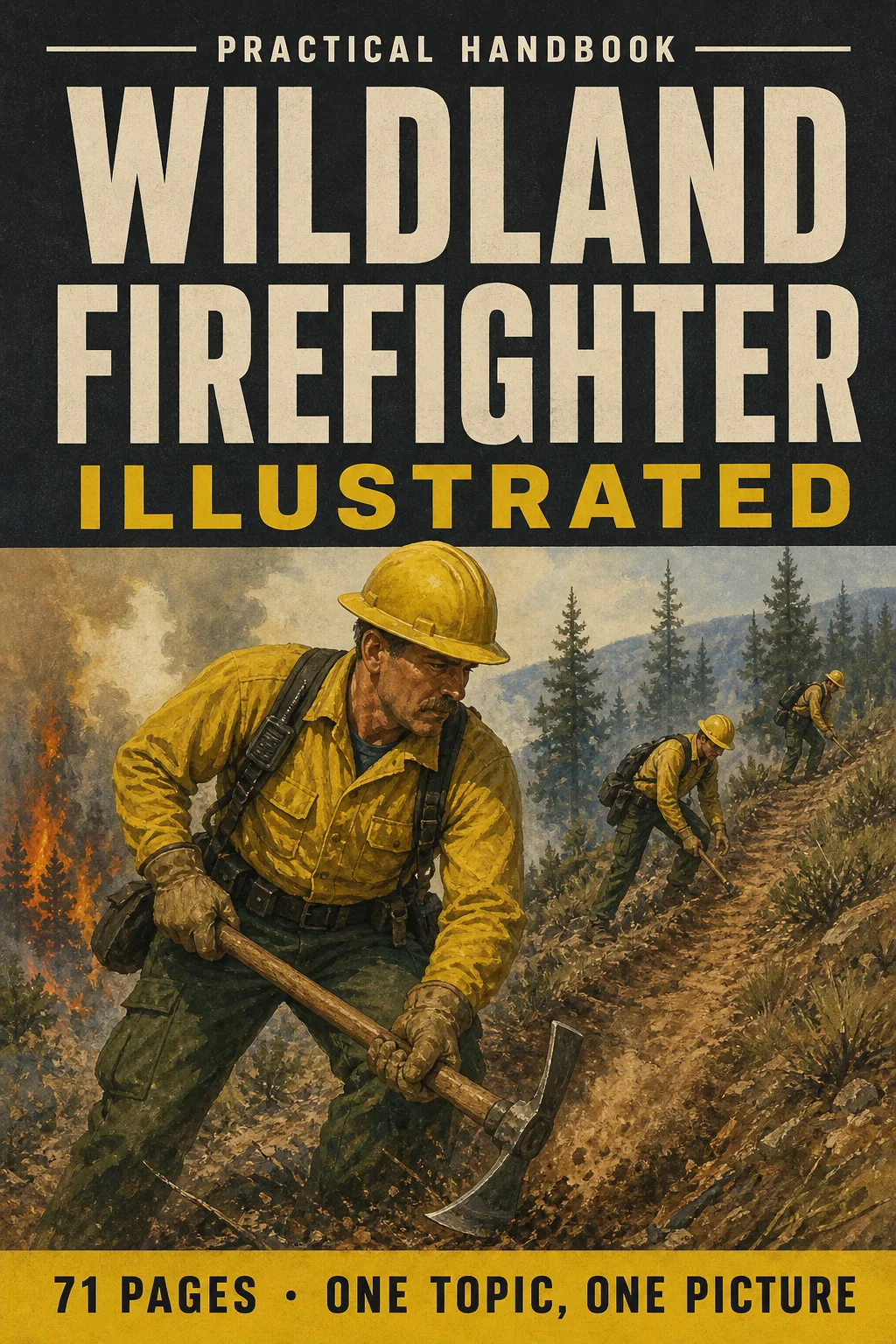
Wildland Fire and Your FFT2 Courses, Illustrated One Topic on Every Page

Fire behavior, parts of a fire, the 10 Orders, the 18 Watch Outs, LCES, safety zones, the fire shelter, hand tools and the pack test. The drawing first, the numbers in a box, so when the squad boss asks, you know where the answer is. 71 illustrated pages.

GET THE ILLUSTRATED BOOK

🔒 Secure checkout · PDF by email · 30-day guarantee

Every topic, its own pageEach order, rule and step drawn, with the explanation right beside it
71 illustrated pages8 parts, from the red card to the review checklists
Up-to-date sourcesNWCG IRPG (PMS 461), PMS 310-1 and the S-130/S-190 courses
PDF by emailFormat

Look Inside the Book

Every page has one big drawing and a box with the numbers, rules and steps you need to know:

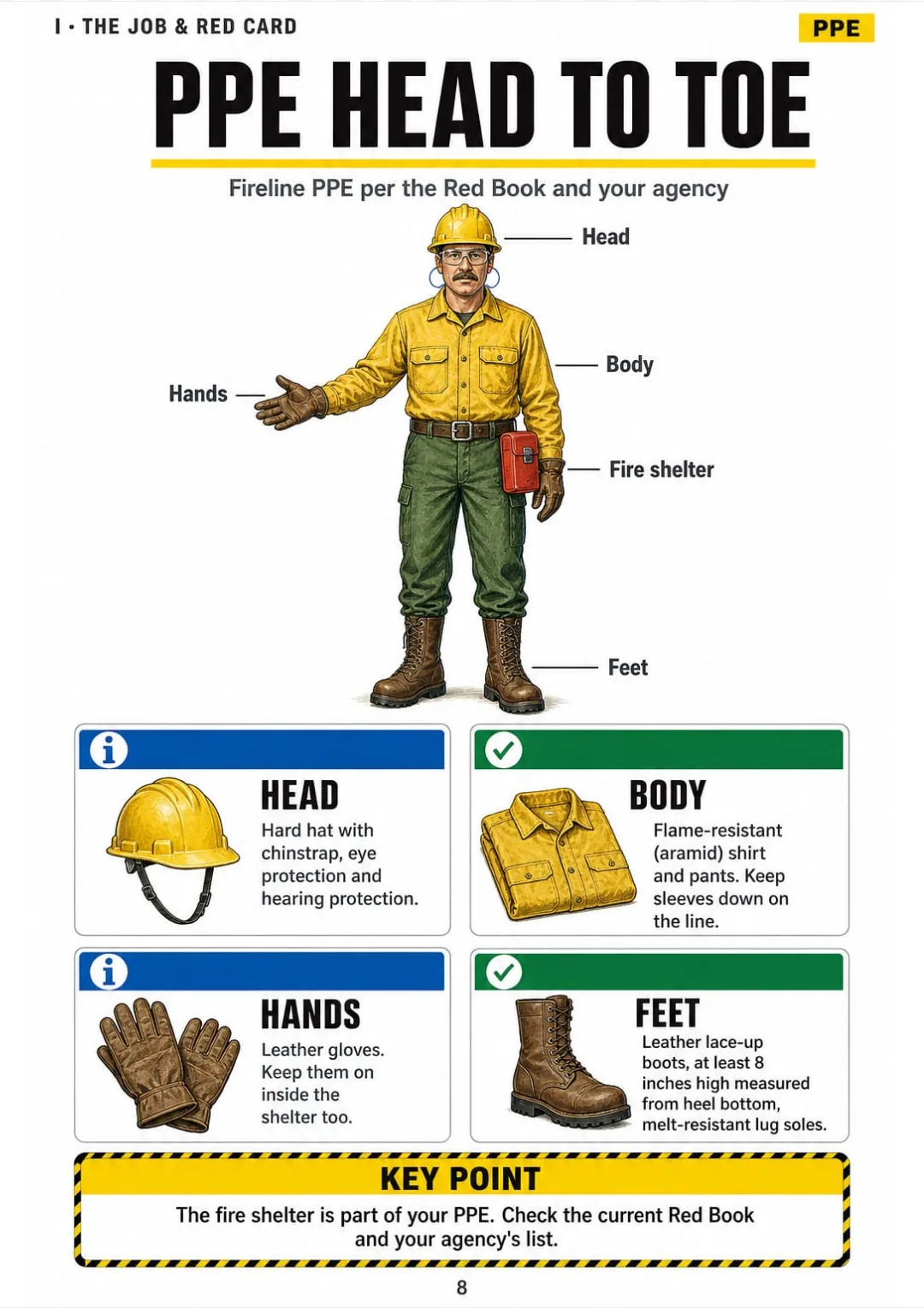
Hard hat, eye and ear protection, FR shirt and pants, leather gloves, shelter, 8-inch leather boots.
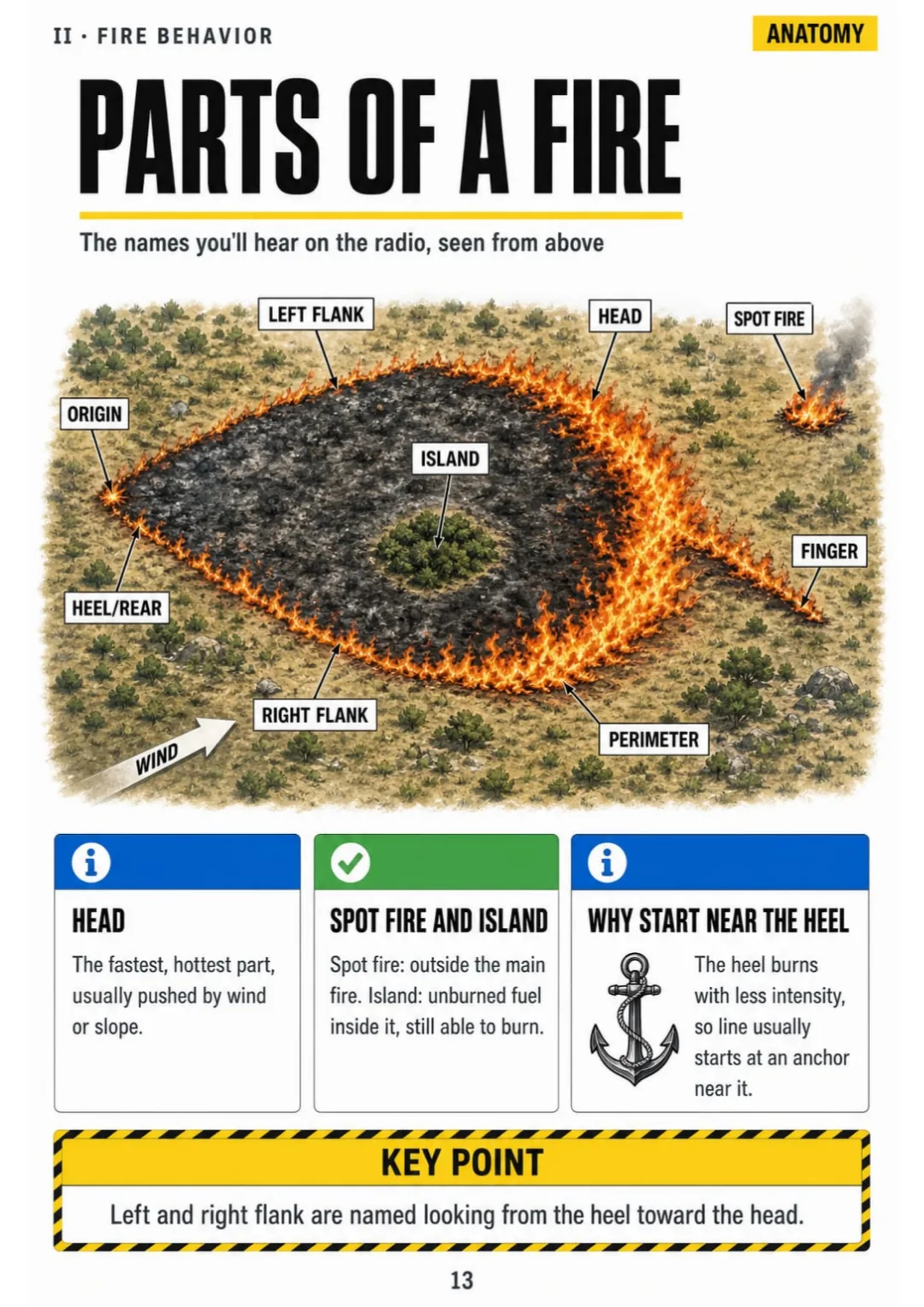
Origin, head, flanks, heel, fingers, spot fire, island, perimeter on one aerial drawing.
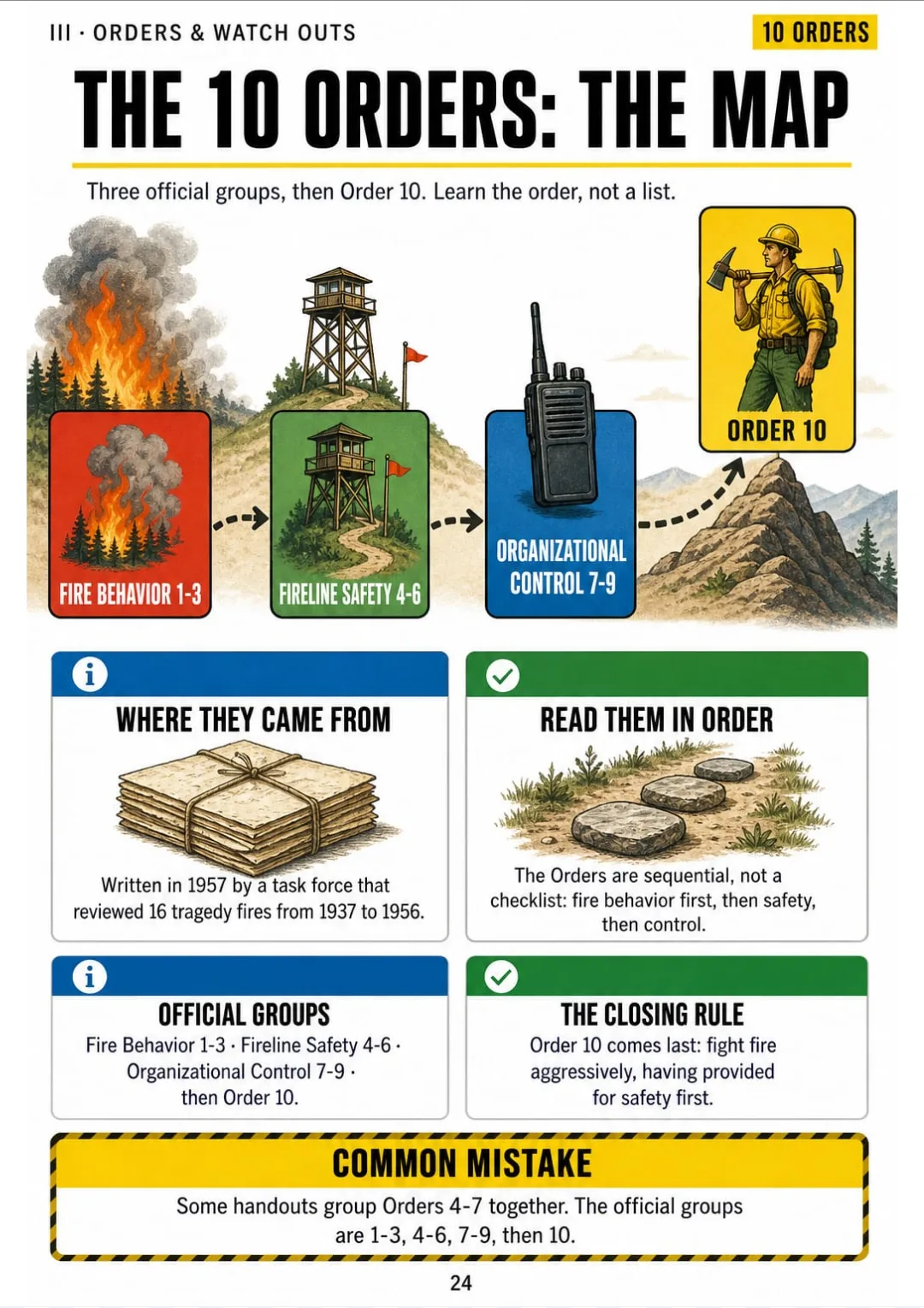
10 Orders: Fire Behavior 1-3, Fireline Safety 4-6, Organizational Control 7-9, then 10.
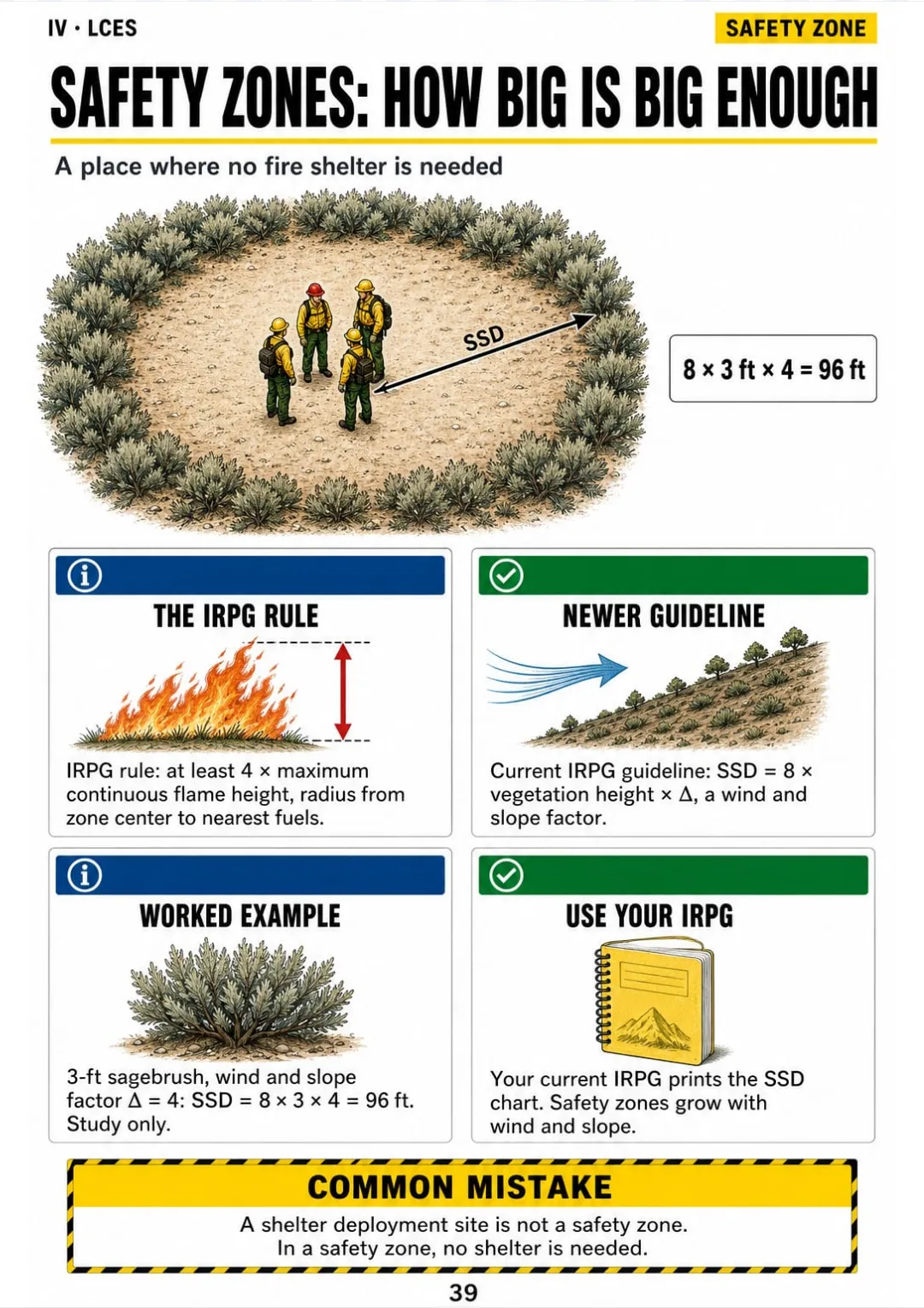
SSD = 8 × vegetation height × Δ — 3-ft brush, Δ 4 → 96 ft
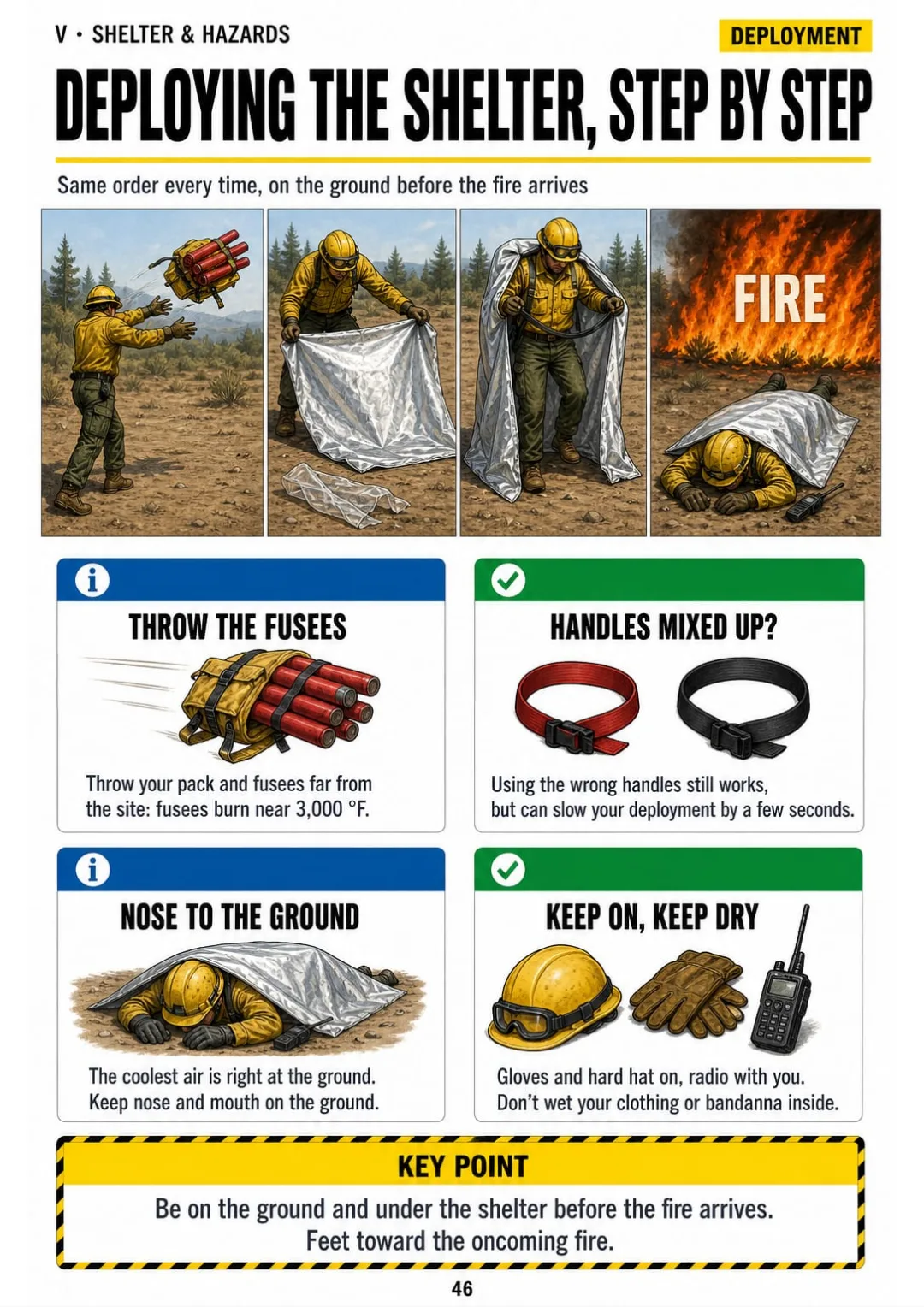
Shelter: right hand red, left hand black, face down, feet to the fire, nose within 1 ft of the ground
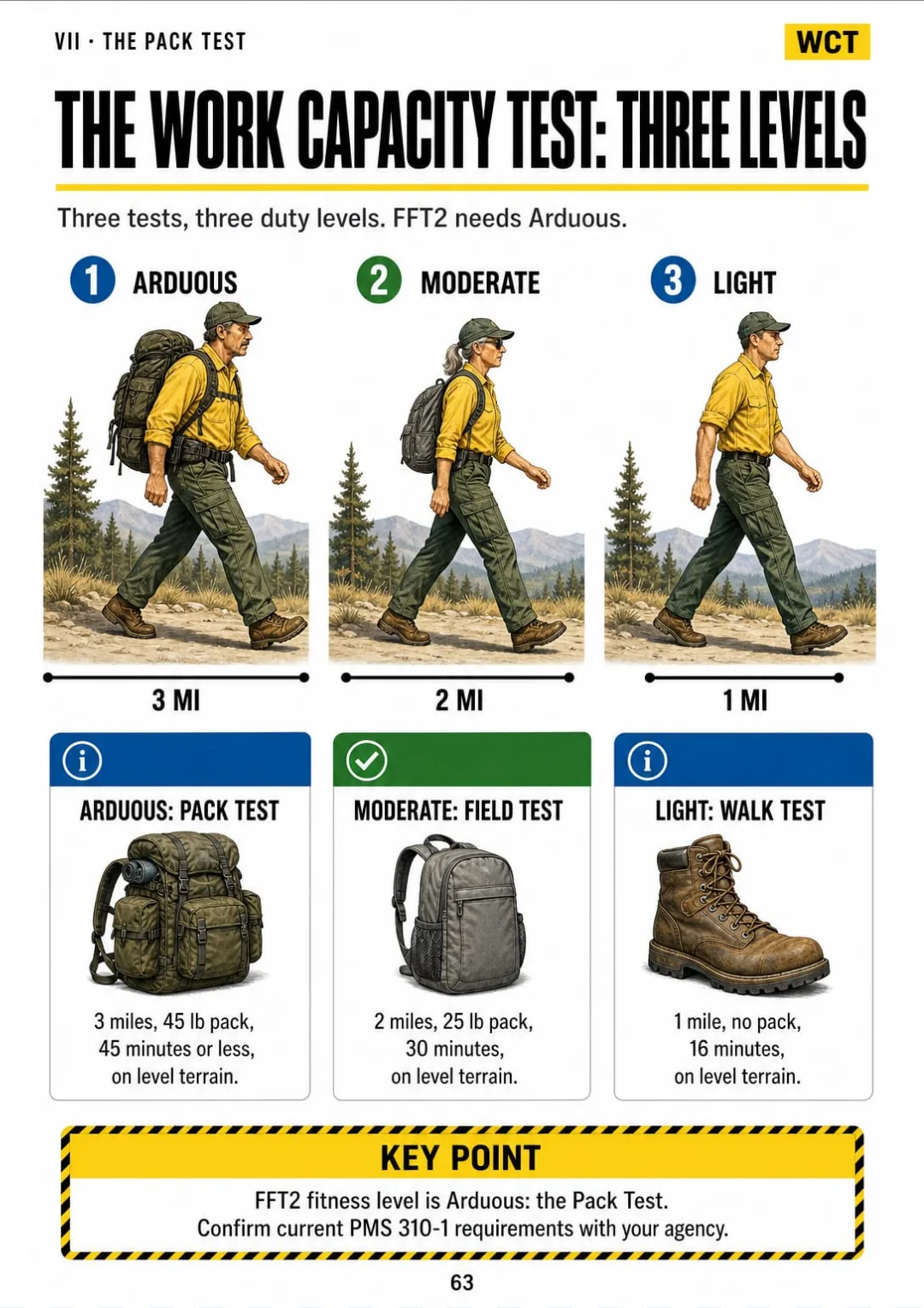
Arduous 3 mi / 45 lb / 45 min · Moderate 2 mi / 25 lb / 30 min · Light 1 mi / 16 min
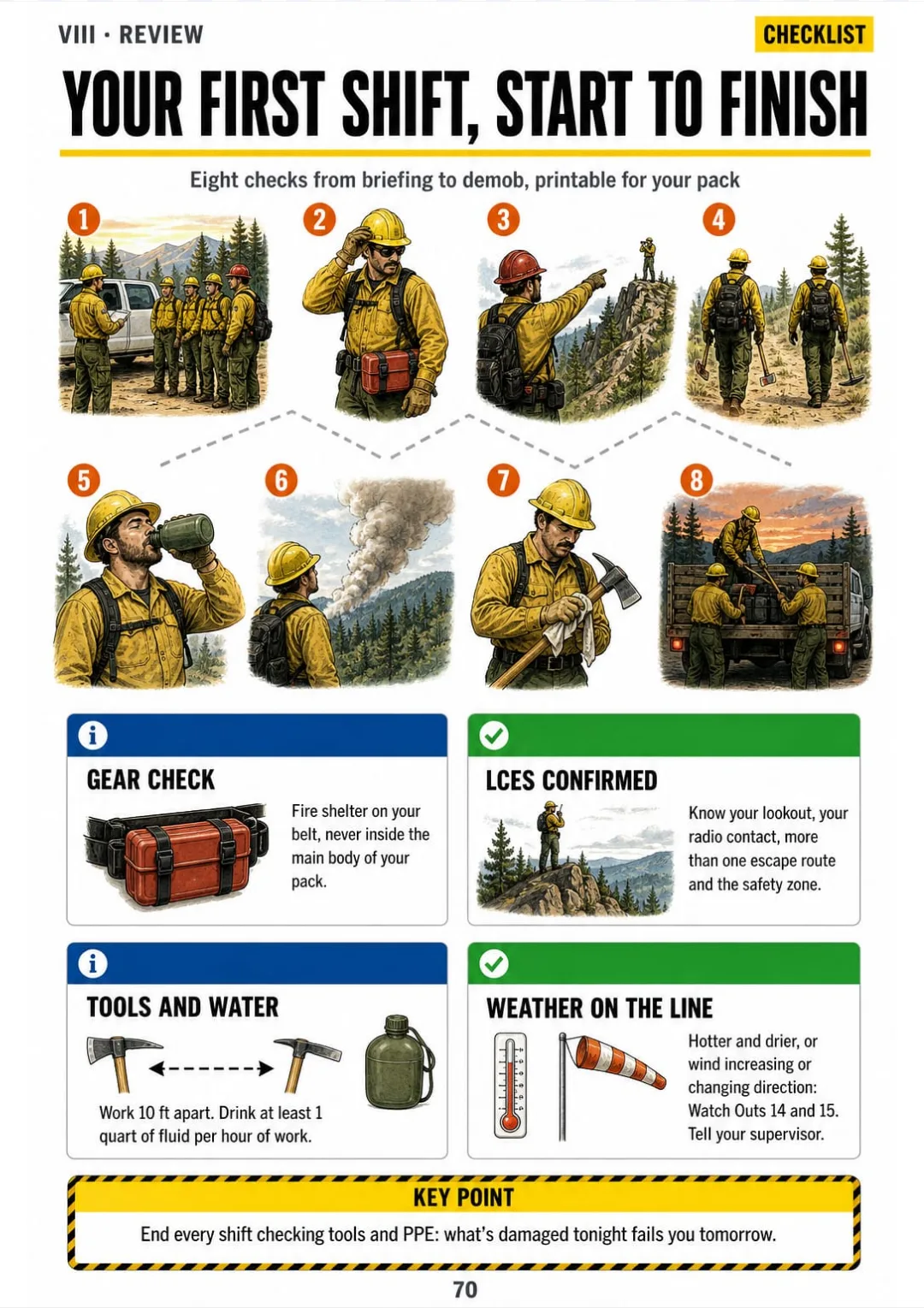
Briefing → gear → LCES → 10 ft spacing → 1 quart/hour → weather → tool check → demob
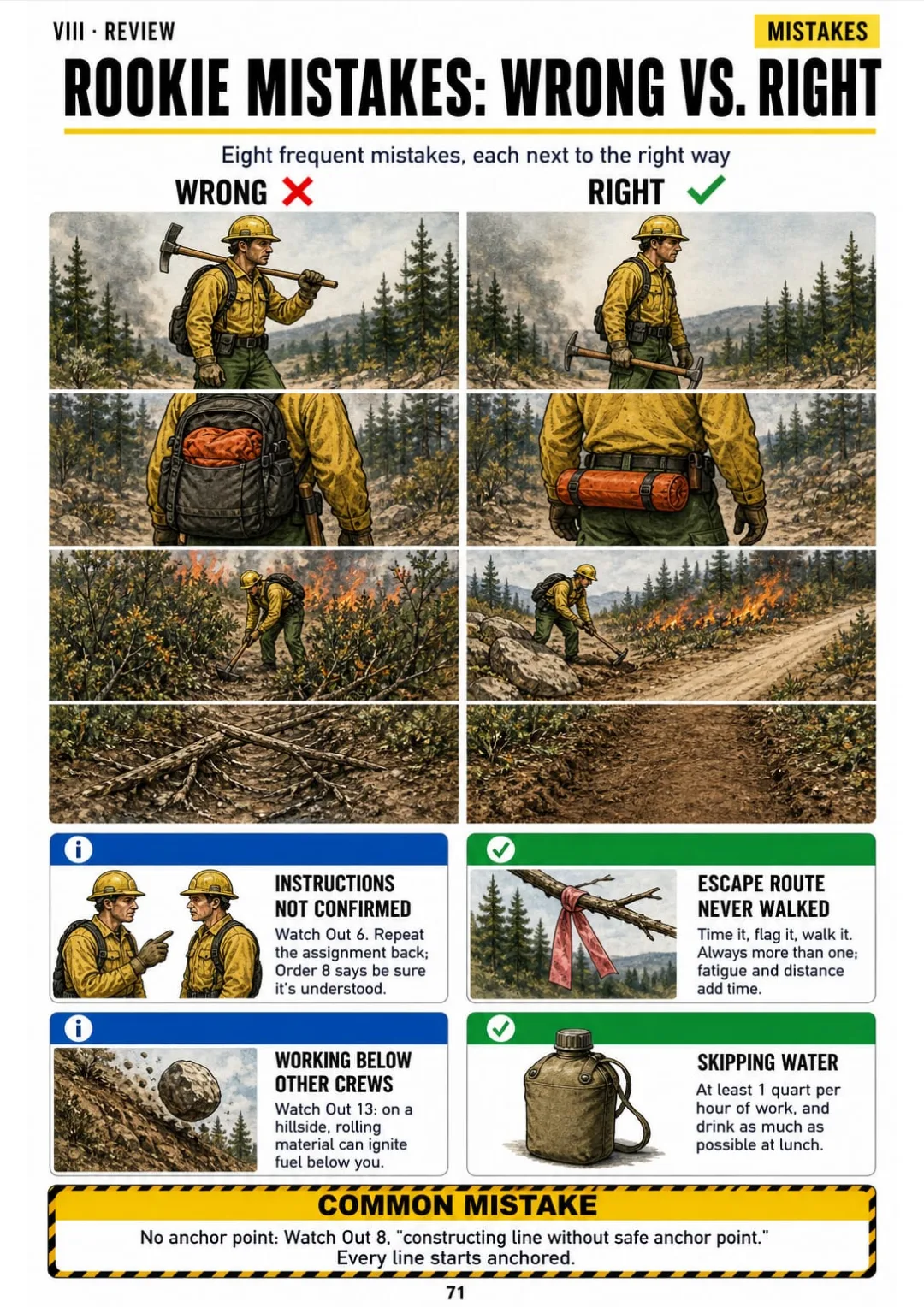
Tool on the shoulder, shelter in the pack, no anchor, roots across the line: wrong vs. right

Swipe to see more →

These are real pages from the book. The table of contents is the full one: 8 parts and 67 topics.

The Problem Isn't You. It's How It Was Explained to You.

It's the morning briefing. Your squad boss looks at you and asks for Standard Firefighting Order number seven. The whole crew is waiting, and the words won't come.

In the course packet, the 10 Orders are ten sentences stacked in a column. Ten lines with nothing tying them together, so by the next day they all run into each other.

10 Orders: Fire Behavior 1-3, Fireline Safety 4-6, Organizational Control 7-9, then 10.

In the book, the 10 Orders are a map: three groups you can see at a glance. Fire Behavior, 1 to 3. Fireline Safety, 4 to 6. Organizational Control, 7 to 9. Then Order 10 on its own: fight fire aggressively, having provided for safety first.

The 18 Watch Outs, LCES, safety zones, the shelter deployment and the Pulaski work the same way: each one has its own page.

You know seven opens the control group, so you know it's communications. You give the answer, and you never have to go back to the packet.

COMPARE FOR YOURSELF

The Same Topic, Two Ways to Study It

THIS
  • The manual: line after line after line
  • The parts of a fire explained only in words
  • You show up to class still unsure
The point of origin is the location where the fire was first ignited. The head of the fire is the most rapidly spreading portion of the perimeter, generally found on the leeward or upslope side. The flanks are the portions of the perimeter roughly parallel to the main direction of spread, designated left and right as viewed from the heel looking toward the head. The heel, or rear, is the portion opposite the head. Fingers are long, narrow strips extending from the main body, while islands are unburned areas within the perimeter.
FOR THIS
  • Every part of the fire on one aerial drawing
  • The terms in one box
  • You see it and you get it
Origin, head, flanks, heel, fingers, spot fire, island, perimeter on one aerial drawing.
CONTENTS

Take a Look at the 8 Parts and 67 Topics

The job and the red card, fire behavior, the 10 Orders and the 18 Watch Outs, LCES, the fire shelter and line hazards, hand tools and building line, the pack test, and review checklists: 71 pages, all illustrated.

IThe Job and the Red Card · pp. 5-10
  1. What an FFT2 Actually Does on the Line
  2. The Red Card and Your Courses
  3. Who's Who: The Chain of Command
  4. PPE Head to Toe
  5. Line Gear: What Goes in Your Pack
  6. The IRPG: The Book That Lives in Your Pocket
IIFire Behavior (S-190) · pp. 11-23
  1. The Fire Triangle: Heat, Fuel, Oxygen
  2. The Fire Behavior Triangle: Fuel, Weather, Topography
  3. Parts of a Fire
  4. How Heat Moves: Conduction, Convection, Radiation, Spotting
  5. Fuel Size and Timelag
  6. Fuel Arrangement: Ground, Surface, Aerial
  7. Fuel Moisture and Probability of Ignition
  8. Temperature and Relative Humidity
  9. The Fire Day: Morning to Night
  10. Wind: Slope, Valley, Fronts and Thunderstorms
  11. Topography: Slope and Aspect
  12. Terrain Traps: Chimneys, Saddles, Narrow Canyons
  13. Warning Signs of Extreme Fire Behavior
IIIThe 10 Orders and the 18 Watch Outs · pp. 24-34
  1. The 10 Standard Firefighting Orders: The Map
  2. Orders 1-3: Fire Behavior
  3. Orders 4-6: Fireline Safety
  4. Orders 7-10: Control, Then Attack
  5. The 18 Watch Outs: How They're Grouped
  6. Watch Outs 1-3: Before You Engage
  7. Watch Outs 4-6: What You Don't Know
  8. Watch Outs 7-9: Line Position
  9. Watch Outs 10-12: Too Close, Can't See
  10. Watch Outs 13-15: Slope and Weather
  11. Watch Outs 16-18: Spots, Escape, Fatigue
IVLCES and Staying Alive · pp. 35-43
  1. LCES: Four Letters, One System
  2. Lookouts: Eyes on the Fire
  3. Communications: The Radio Call
  4. Escape Routes: Timed, Flagged, Walked
  5. Safety Zones: How Big Is Big Enough
  6. The Common Denominators of Fatal Fires
  7. Look Up, Look Down, Look Around
  8. The Risk Management Process
  9. Human Factors (L-180): How Good Crews Get Hurt
VFire Shelter and Line Hazards · pp. 44-50
  1. The Fire Shelter: Last Resort, Not a Plan
  2. Choosing a Deployment Site
  3. Deploying the Shelter, Step by Step
  4. Snags, Rolling Rocks and Burning Debris
  5. Aircraft and Retardant Drops
  6. Heat Illness and Hydration
  7. Lightning, Power Lines and Other Hazards
VIHand Tools and Building Line · pp. 51-62
  1. The Pulaski
  2. McLeod, Combi Tool and Shovel
  3. Carrying, Spacing and Sharpening Tools
  4. The Anchor Point: Where Every Line Starts
  5. Direct, Parallel and Indirect Attack
  6. Fireline: Width, Depth and Mineral Soil
  7. Cup Trenches and Line on Slopes
  8. The One-Lick Method
  9. Downhill Line Construction Checklist
  10. Hose Lays and Using Water
  11. Firing Operations: What You Need to Know as an FFT2
  12. Mop-Up and Cold Trailing
VIIThe Pack Test · pp. 63-65
  1. The Work Capacity Test: Three Levels
  2. Training for the 3 Miles with 45 lb
  3. Test Day: Gear, Pace and Rules
VIIIReview and Checklists · pp. 66-71
  1. The Briefing Checklist: What You Should Know Before You Hit the Line
  2. All the Acronyms on One Page
  3. The Numbers to Remember
  4. The 10 Orders and 18 Watch Outs: Quick Recall
  5. Your First Shift: Start-to-Finish Checklist
  6. The Most Common Rookie Mistakes on the Line

One Page, One Topic, All Clear

Think of it this way:

You're on the line and the fire starts moving upslope. Your crew boss asks where the safety zone is, and whether it's big enough.

You studied that page the night before: 8 × vegetation height × the slope-wind factor, with a worked example. Three-foot brush, factor 4, 96 feet. You run the numbers in your head and you answer.

Shelter: right hand red, left hand black, face down, feet to the fire, nose within 1 ft of the ground

Same with the parts of a fire, the 10 Orders, the shelter deployment, the Pulaski and the pack test: each one on its own page.

Wildland Firefighter Illustrated is 8 parts and 67 topics, all drawn, and it ends with review checklists, every acronym on one page and the numbers to remember.

What you see drawn, you don't have to memorize.

What's Inside Wildland Firefighter Illustrated:

Ipp. 5-10

The Job and the Red Card

What an FFT2 does on the line, the red card and your courses, the chain of command, PPE head to toe, your line gear and the IRPG.

IIpp. 11-23

Fire Behavior (S-190)

The fire triangle and the fire behavior triangle, parts of a fire, how heat moves, fuels and timelag, relative humidity, the fire day, wind, slope, terrain traps and the warning signs.

IIIpp. 24-34

The 10 Orders and the 18 Watch Outs

The 10 Standard Firefighting Orders in their three groups, and the 18 Watch Out Situations, three at a time, each with a line scene.

IVpp. 35-43

LCES and Staying Alive

LCES, lookouts, the radio call, escape routes, safety zone sizing, the common denominators of fatal fires, risk management and human factors.

Vpp. 44-50

Fire Shelter and Line Hazards

The fire shelter as a last resort, picking a site, deploying it step by step, snags and rolling rocks, aircraft and retardant, heat illness, lightning and power lines.

VIpp. 51-62

Hand Tools and Building Line

The Pulaski, McLeod, combi tool and shovel, tool spacing, the anchor point, types of attack, fireline specs, cup trenches, one-lick, downhill line, hose lays, firing and mop-up.

VIIpp. 63-65

The Pack Test

The three Work Capacity Test levels, how to train for 3 miles with 45 lb, and what to bring and expect on test day.

VIIIpp. 66-71

Review and Checklists

The briefing checklist, every acronym on one page, the numbers to remember, quick recall of the Orders and Watch Outs, your first shift and the most common rookie mistakes.

At the end of the book: Review checklists, every acronym on one page and the numbers to remember.
Plus: 2 Free Books

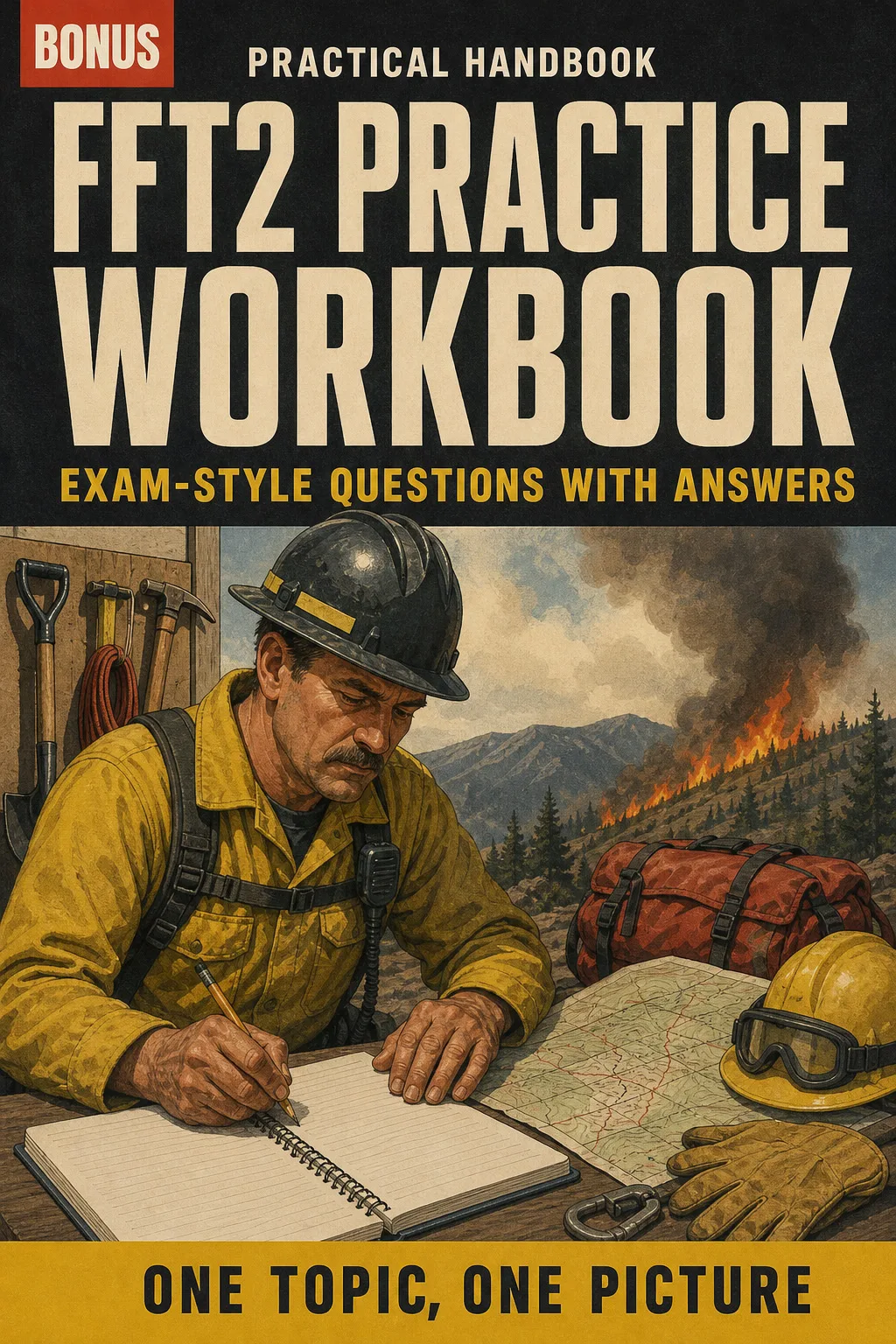
FFT2 Practice Workbook: Exam-Style Questions with Answers

BONUS 1: «FFT2 Practice Workbook: Exam-Style Questions with Answers»

Value on its own: US$ 17.90

Test yourself topic by topic with exam-style questions and short explained answers, so you know what you really have down before class.

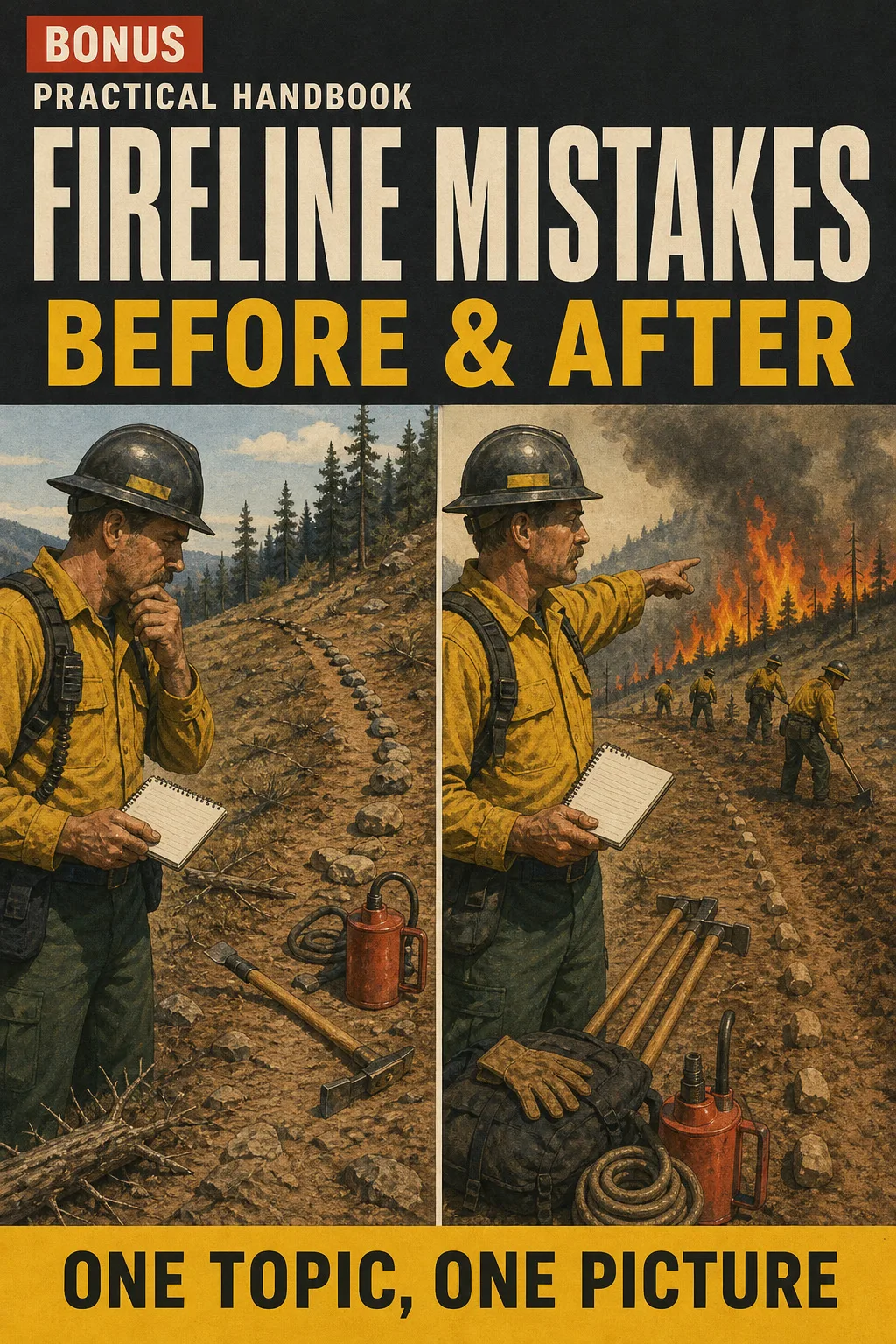
Fireline Mistakes: Before & After

BONUS 2: «Fireline Mistakes: Before & After»

Value on its own: US$ 14.90

The 15 most common rookie mistakes on the line, each drawn wrong and right, so you can review them the night before your course or your first assignment.

Wildland Firefighter Illustrated with 2 Free Books

  • Wildland Firefighter Illustrated: 71 illustrated pagesUS$ 63
  • BONUS 1: FFT2 Practice Workbook: Exam-Style Questions with AnswersUS$ 17.90
  • BONUS 2: Fireline Mistakes: Before & AfterUS$ 14.90
  • High-resolution PDF to printIncluded
Total value US$ 95.80
YOUR PRICE:
US$ 27
You save US$ 68.80
YES, I WANT WILDLAND FIREFIGHTER ILLUSTRATED FOR US$ 27

📄 This is a digital PDF book sent to your email: nothing is printed or shipped.

Secure purchaseEncrypted payment30-day guarantee

PDF by email: We email you Wildland Firefighter Illustrated as a PDF, together with the two free books. It's a single payment: no installments, no extra charges.

Who This Book Is For

You're taking S-130 and S-190

You're taking S-130 and S-190

Every topic from the course on one drawn page, so after class you review what you saw instead of rereading the packet.

Your pack test and first season are coming up

Your pack test and first season are coming up

The test levels, the numbers to remember and your first shift, start to finish, on pages you can print and carry in your line gear.

You already carry a red card

You already carry a red card

A quick review before your annual refresher: the 10 Orders, the 18 Watch Outs, LCES and safety zones, back in order.

Everything You Get Today

US$ 95.80US$ 27
YES, I WANT WILDLAND FIREFIGHTER ILLUSTRATED FOR US$ 27

📄 This is a digital PDF book sent to your email: nothing is printed or shipped.

30DAYS
GUARANTEE

30-Day Guarantee

Try Wildland Firefighter Illustrated for 30 days, bonus books included.

We refund everything if the file won't open, if the book isn't what you see here, if you were charged twice or if the email doesn't arrive. Just email us.

You pay once. No subscriptions.

Frequently Asked Questions

Is it for me if I'm new to wildland fire, or I come from structural firefighting?

Yes. It starts from the basics of the FFT2 job and explains wildland fire's own rules, so it works for a first-timer and for a structural firefighter going after a red card.

Where does the content come from?

It's checked against the current editions of the NWCG publications: the Incident Response Pocket Guide (PMS 461), PMS 310-1, the S-130, S-190 and L-180 course material, fire shelter guidance and the federal Work Capacity Test standards. NWCG updates its material from time to time. If your instructor or agency uses a newer version, follow theirs.

Is this official material?

No. It's an independent illustrated study companion. It isn't published or endorsed by NWCG or any agency.

Does it replace the S-130, S-190 and L-180 courses?

No. You still need the required training, the field day and hands-on fire shelter practice. The book doesn't give you a certificate and doesn't count toward your red card. It helps you review what you learn in those courses.

Are the practice questions the ones on the exam?

No. They're written for this book to help you check what you've got down. They aren't official exam questions.

When and how do I get it?

The book and the 2 bonus books come as a PDF by email, sent to the address you enter at checkout.

The NWCG material is free online. Why pay for this?

It is, and it's the source this book is checked against. It's also hundreds of pages of text. Here every topic is one drawn page with the numbers in a box, so you can review fast and keep it in your pack. One-time payment, no subscription.

Can I get it on paper?

It's a PDF, so you can print the whole book or just the pages you want to keep in your pack.

How does the refund work?

You have 30 days. We refund everything if the file won't open, if the book isn't what you see on this page, if you were charged twice or if the email doesn't arrive: just email us.

Before You Close This Page

No more rereading the packet and having nothing stick.

You see the 10 Orders drawn, and you've got them.

You show up to class and to the line knowing where everything is.

Drawings make studying faster.

The book is right below.

One-time payment: US$ 27 · Guarantee: 30 days · PDF by email

YES, I WANT WILDLAND FIREFIGHTER ILLUSTRATED FOR US$ 27

📄 This is a digital PDF book sent to your email: nothing is printed or shipped.